
When Convenience Becomes a Lifeline
Telehealth was once seen as a convenience—a way to check in with your doctor between commutes or after hours. But for millions of Americans, especially since the oridinal telehealth expansion during the COVID-19 pandemic, it has become a lifeline.
If you’re a rural patient with no nearby clinic, a parent without childcare, someone living with a disability, or simply uninsured or underinsured—telehealth might be your only realistic way to access care. Even still, telehealth may be a lofty goal for some patients due to lack of or low broadband in many rural areas of the country.
In any case, now that lifeline is being cut. Not because it doesn't work. But because of they were temporary responses and not treated as infrastruction to integrate long term – bottom line, they weren’t made permanent. Now, polititcal gridlock has create a policy failure . the current shutdown forced the expiration by stalling all progress.
What's Happening?
As of October 1, 2025, the U.S. federal government shut down, triggering the expiration of pandemic-era Medicare telehealth waivers. These were the very policies that allowed:
- Virtual visits from home (no clinic required)
- Behavioral and mental health care via phone or video
- Reimbursement for care by Federally Qualified Health Centers (FQHCs) and Rural Health Clinics (RHCs)
- Access to care from a broader range of providers
Congress failed to act before the deadline, and because of the shutdown, no new funding or policy extensions could be passed. The Centers for Medicare & Medicaid Services (CMS) has recalled only essential staff to manage open enrollment—but telehealth claims processing and reimbursement guidance remain delayed or on hold.
The Triple Threat: Patients, Providers, and Insurers
Patients
If you’re a Medicare beneficiary, you may now have to physically travel to a healthcare facility just to access virtual care—because the 'originating site' rules have returned. That means no more telehealth from your home for many services. Mental health access via phone is also at risk, despite its proven success during the pandemic.
Providers
Clinics and hospitals—especially in underserved and rural areas—that built telehealth infrastructure under pandemic waivers are now unsure how or if they’ll be reimbursed. Some are scaling back virtual offerings, cutting staff, or pausing new patient intake. This deepens the gap in care access for those already medically marginalized.
Insurers
With federal guidance paused and Medicare reverting to pre-pandemic rules, many insurers are scrambling to clarify what they will and won't cover. That uncertainty puts patients in billing limbo, and small providers at financial risk—especially those dependent on CMS-based reimbursement models.
What You Can Do Right Now
- Talk to your provider about whether your telehealth services are changing.
- Call your senators and representatives. Demand a return of Medicare telehealth flexibilities and protections.
- Support local clinics and orgs that serve vulnerable populations—they're fighting to stay open.
- Share your story. Your personal experience with telehealth can move policy forward.
This moment isn't just about disconnected Zoom calls or dropped video visits. It's about whether healthcare is seen as a right or a privilege. It's time to connect the dots—and fight for a system that doesn't leave anyone behind.
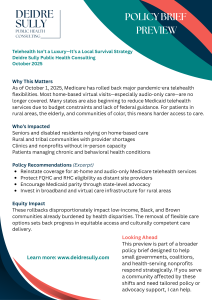
Download free policy brief preview.
Sources:
- American College of Radiology. (2025, October 1). Medicare telehealth flexibilities impacted by government shutdown. Retrieved from https://www.acr.org
- American Telemedicine Association. (2025, October 14). Day 14 of the Telehealth Shutdown: The Ripple Effect on Telehealth Reimbursement. Retrieved from https://www.americantelemed.org
- Centers for Medicare & Medicaid Services. (2025, October 15). MLN Connects Newsletter – Telehealth provisions and claims hold. Retrieved from https://www.cms.gov
- Health Journalism Blog. (2025, October 8). How the shutdown is impacting telehealth and hospital-at-home programs. Retrieved from https://healthjournalism.org
- Rural Health Information Hub. (2025, July 17). Healthcare Access in Rural Communities: Telehealth and Broadband Issues. Retrieved from https://www.ruralhealthinfo.org